


Unclaimed Baggage : 4X Conversion Increase using Personalized Recommendations


Read summarized version with
Given today’s unpredictable business landscape, increasing productivity whilst delivering exceptional products and services is now more important than ever.
Unclaimed Baggage understood that to maintain its competitive advantage and process large volumes of one-of-a-kind items, it needs to maximize each item’s potential for a second life. The company holds the distinction of being the only store in the U.S. that sells items of every traveler’s worst nightmare — lost baggage.
Unclaimed Baggage has its store in Scottsboro, Alabama, nearly 50 miles from the nearest commercial airport. It is basically a retail store that holds thousands of bags lost in transit, ranging from rare tools to monogrammed engagement rings. Over the years, the company’s unique business had become a globally recognized tourist destination.
Of the lost luggage retrieved, only one-third of the items in the luggage end up in the store, ranging anywhere from 20%-80% off its list price. Moreover, the company donates almost half of the merchandise to charities: clothes go to homeless shelters, wheelchairs go to prisons and veteran groups, and strollers go to teen pregnancy centers.
The Challenge
Providing Relevant Recommendations for Single Quantity Products While Increasing Conversions and Average Order Value
To stay ahead of the competition, every company needs to monitor and review their sales pages — are they converting, and how can you improve conversions?
When it comes to working on personalized recommendations offsite, Unclaimed Baggage isn’t a new name in the e-commerce industry. However, since the company launched its online website a few months back, it began facing a few common complications that almost all companies have faced during their initial phases of the website launch, including how to improve conversion and click-through rates and average order value (AoV).
Moreover, since all the items from the unclaimed luggage came in a single piece, it was a little challenging to personalize the products. To address these problems, Unclaimed Baggage reached out to Loopclub to strategize on improving product recommendations on Shopify.
The Solution
Maximize Conversions and Click-Through Rate
Unclaimed Baggage uncovered statistically significant differences in the conversion rate and AoV rate of purchasers.
Using our product recommendations model and proper optimization to dive deeper into customer behavior, the company saw conversion rates of almost 9% for users who interacted with the personalized widgets.
Personalized Onsite Experience
Using LoopClub’s product recommendations, Unclaimed Baggage recommended the most relevant items to buyers in real-time based on historical data as well as products they’ve been browsing in their current session.
Moreover, LoopClub created a custom recommendation model to understand products and buyer preferences using product metadata and target the right customers. Since using our Personalized Recommendations, the onsite experience for Unclaimed Baggage has become even more personalized for customers.
Creating the Right Product Groups and Customer Groups
In the past, product recommendations were not adequately attuned to buyer preferences and would cost the company the opportunity to cross-sell and increase conversions. This was made even more complicated by the fact that each product has only one quantity. This made it difficult to use the past purchases to show recommendations.
LoopClub created a new recommendation model to address this problem. Multiple products were grouped in buckets based on their metadata, description, title, tags, price, etc to create significant data. This exercise was repeated for visitors as well based on their behaviour. This grouping made it easier for the model to understand which product group to target to a particular user. Hence giving higher conversions and Click through Rate.
This helped us in delivering hyper-personalized experiences for people who landed on Unclaimed Baggage’s website.
The Result
Leveraging Google Analytics, we tracked the high-performing conversions. We later worked on rolling out the new recommendation model to increase the click-through rates to all the visitors.
Additionally, we wanted to increase the conversion rate to augment the interaction with the users, thereby generating more revenue.
With the users interacting on the personalized recommendations, the AoV reached as high as $160 as opposed to $110 without the implementation of personalized recommendations. Moreover, the conversion rate was found to be between 8% and 9% compared to a mere 2.5% without recommendation touch points.
It is clear that Personalized Recommendations can help an e-commerce store in increasing conversions & AoV. If you are interested in using Personalized Recommendations for your store, reach out to us and we'll get you started.
Sign Up For Our Free Weekly Newsletter
Get the latest e-commerce insights, tips, and strategies delivered straight to your inbox.

Hiten Vats
I'm a software engineer
You May Also Love to Read
5 Ways to Use OpenClaw for D2C Marketing
We work every day with Shopify brands, trying to do more with less. The conversations are almost always the same. A founder with a great product, a team of three or four, and a growing list of channels: TikTok, Instagram, email, SMS, Reddit, and a dozen more. Each one needs a different format, a different hook, a different tone. The team can usually handle any one of them well. Just not all of them at once. The global D2C market reached $163 billion in 2024 and is projected to reach $595 billio
May 1, 2026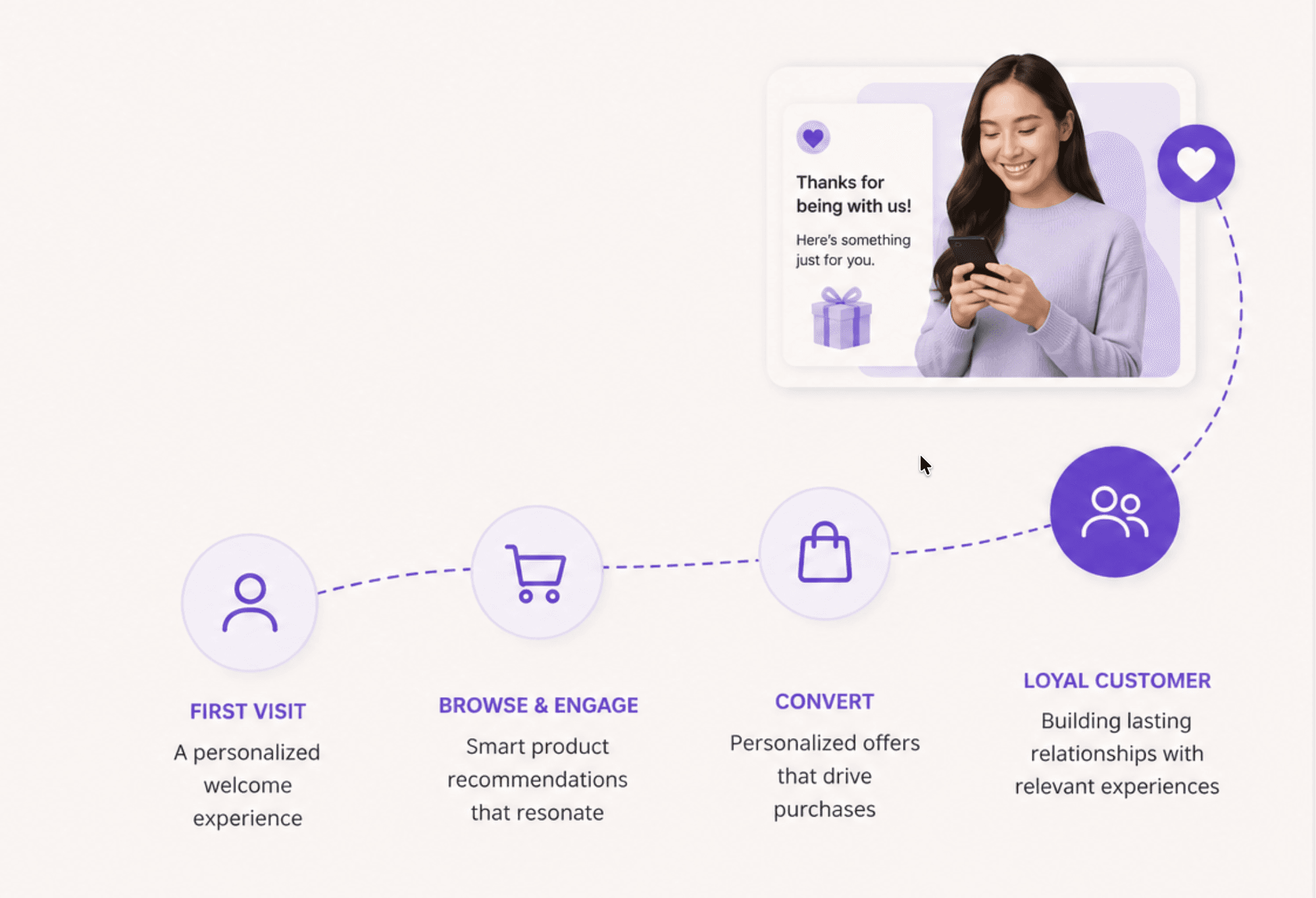
From First Visit to Loyal Customer: How Glood.AI Personalizes the Entire D2C Journey
Most personalization tools optimize one moment. Glood.AI personalizes the entire customer journey, from the first click through the fifth purchase and beyond.
Apr 30, 2026
How Glood.AI's Real-Time AI Engine Turns Shopper Behavior Into Revenue: Session by Session
Here's what happens on most Shopify stores, almost a thousand times a day. A customer lands on your online store and clicks through three products. They spend 90 seconds reading the ingredient panel on one of them, add something to the cart, hesitate, and remove it. They browse a “related products” or “recommended” category. And then they leave, without buying. Two hours later, your analytics dashboard and session recordings tool show you exactly what happened. Which pages the customer visited
Apr 30, 2026