


From First Visit to Loyal Customer: How Glood.AI Personalizes the Entire D2C Journey
Read summarized version with
Most D2C personalization strategies optimize for one thing - the first purchase. Get the visitor to convert, close the cart, and bag conversion. That's where the thinking stops. What happens after the first order, the thirty days that determine whether this person becomes a repeat buyer or a one-time transaction, gets handed off to a generic email sequence and a promotional code.
That's a problem, because the first purchase isn't the finish line. It's the starting gun.
Acquiring a new customer costs 5-7X more than retaining an existing one. Repeat buyers spend 67% more per transaction than first-time buyers. A customer who makes three purchases with a D2C brand generates, on average, 4X the lifetime revenue of one who buys once. The entire revenue model of D2C commerce is built on retention, yet most personalization infrastructure is designed for acquisition.
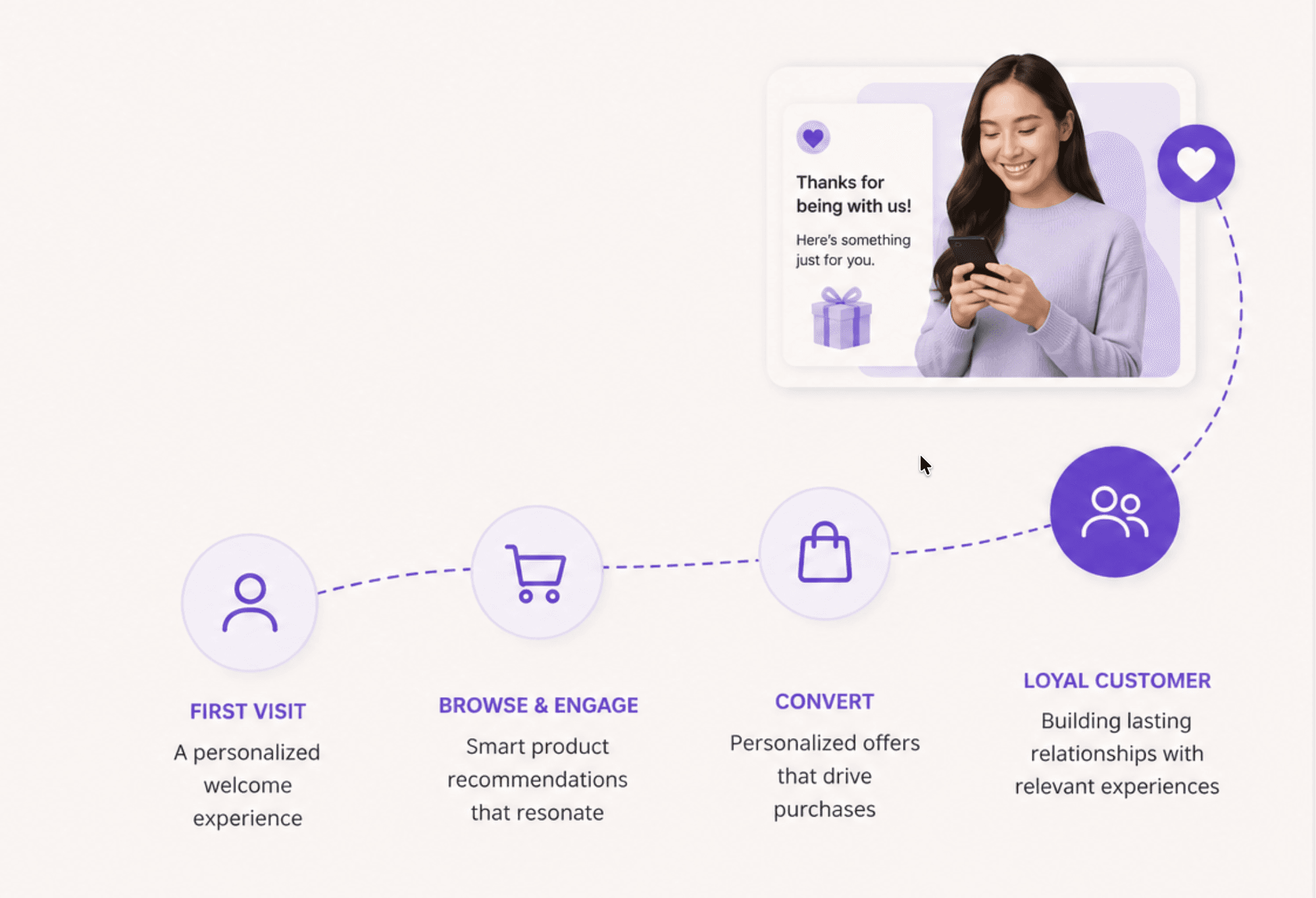
In this blog, let's walk through what full-journey personalization actually looks like, stage by stage, and how Glood.AI makes it operational without a data science team.
Stage One: The First Visit - When AI Has the Least Data and the Most to Prove
A brand-new visitor is a blank slate. No purchase history and no prior sessions. Just the behavioral signals from the next few minutes, whatever they click, scroll pattern, or spend time on different pages.
Most personalization systems respond to this by falling back to bestsellers. Instead, Glood.AI reads everything available from the very get-go.
- Traffic source is the first signal: A visitor from a paid Meta ad for a specific product is in a completely different headspace than one who arrived through a Google search for a category keyword. UTM parameters tell Glood.AI what the customer was shown before they arrived, which shapes what is featured first. Don't show a generic homepage to someone who clicked an ad for a specific product.
- In-session behavior builds fast: Within two minutes of a visit, a customer has generated meaningful signals - what they clicked, scrolled, how much time they spent on any product description, and whether they went to the cart or back to the category page. Glood.AI processes these continuously. By the time a customer reaches the fourth or fifth page of a session, the recommendations they see are already shaped by their actions in that session, even without any prior history.
The goal of the first visit isn't just to convert. It's to convert with the right product, because that first purchase seeds the AI's understanding of who this customer is. Get it right here, and everything downstream benefits.
Stage Two: The First Purchase, and Why the Confirmation Page Is Wasted on "Thank You"
Most Shopify stores use the order confirmation page to display an order number and a thank-you message. The customer closes the tab.
That's the wrong call. The moment the purchase is confirmed, trust in your brand is at its absolute peak. The hesitation, the second-guessing, and the comparison shopping, all of it is gone. The customer already said yes. They're not going anywhere.
Here, Glood.AI fires a single, AI-selected "Add to Order" offer at this moment. It doesn’t show a product gallery or a generic "customers also viewed" section. Rather, it shows one item, chosen because it complements what was just purchased and fits the price point this customer just demonstrated comfort with. One-click add, no re-entering payment details, no navigating back through the cart, no new checkout.
Conversion rates for these post-purchase offers range from 15% to 22% for well-matched products. That is consistently the highest-converting touchpoint on any store that actually uses it.
For a store processing 2,000 orders a month, converting 15% of post-purchase offers at an average of $25 per accepted offer, generating at least $90,000 in annual incremental revenue from a page that previously generated nothing.
The first purchase also sets the stage for everything downstream. Category, price point, channel, and device all tell Glood.AI who this customer is and inform how it will personalize their next visit, email, and recommendation.

Stage Three: The 30-Day Window That Decides Whether They Come Back
Most D2C customers decide whether to repurchase within 30 days of their first order. If they don't re-engage in that window, a second purchase, a deep email click, or a return visit to the site, the probability of them becoming a regular buyer drops sharply.
What do most brands do during this window? They send the same email sequence to every customer in the post-purchase cohort. The same product recommendation at day 10. The same promotional offer on day 15. Generic, because there's no personalization layer connecting what each individual bought to what they should be shown next.
Glood.AI makes this window intelligent. Because it knows what the customer bought and what they engaged with during their purchase session, it can inform your marketing channels, email, SMS, and push, about which products to feature for this specific customer in what sequence. Not what's popular this week. What this customer is most likely to want, based on their behavior.
For consumable products, replenishment logic is critical. For instance, a skincare brand selling a 30-day moisturizer should send a targeted reorder prompt at day 25, before the customer runs out and picks up an alternative from a competitor
Glood.AI calculates this timing from product data and purchase date, not from a generic "day 28 email" rule that someone configured once and forgot.
For non-consumables, the 30-day window is about cross-category expansion. The first purchase is a declaration of taste. Glood.AI uses it to identify which other products in your catalog appeal to customers with that purchase profile and to ensure those products receive prominent placement on the next visit and in the next communication.

Stage Four: The Repeat Buyer & Where LTV Is Actually Built
By the time someone makes their third purchase, they know your brand. They trust your quality and do not need onboarding. What they need and what keeps them coming back is to feel like the store knows them back.
This is where most Shopify personalization implementations get complacent. They complete the first order, set up a retention email sequence, and call it done. The returning customer shows up on the same homepage as a first-time visitor and gets shown the same "new arrivals" section. Sees the same featured products.
Here. Glood.AI brings the difference. It re-ranks the returning-customer homepage based on purchase history and prior session behavior:
- Someone who has bought activewear twice sees performance accessories and new athletic releases at the top.
- Someone who's bought in the home goods category sees tableware and accent pieces first.
- The navigation stays the same. The product grid re-orders itself around who this person actually is.
For high-LTV customers, especially the top 20% by lifetime spend, Glood.AI applies a different logic entirely.
It shows premium variants, exclusive combinations, and early access to new products. The AI automatically identifies this tier from their purchase behavior and doesn’t require any manual tagging or segment rules to configure. It just applies behavioral intelligence to the customers who deserve a different treatment.
What a Full-Journey Experience Looks Like in Practice
Let's walk through a real scenario.
A new customer arrives at ABCLab, a D2C haircare brand, from a paid Instagram ad for a frizz-control shampoo. Glood.AI reads the UTM source and shows the shampoo prominently, alongside a "customers who loved this also tried" section featuring a matching conditioner and a smoothing serum.
The customer adds the shampoo. At the cart, Glood.AI fires a single bundle offer, showing the shampoo with a conditioner, triggering a modest saving for the buyer. They accept and check out.
On the confirmation page, Glood.AI shows one post-purchase add-on, say, a scalp oil that customers who bought this exact combination frequently purchased within two weeks. One tap and it's done. The order grows by $28.
On day 25, Glood.AI signals the email system. This customer gets a targeted replenishment prompt and not a generic "we miss you" offer, but a message specifically about reordering the shampoo and conditioner before they run out.
When the customer returns, their homepage features new arrivals in the color-treated hair subcategory and a "complete your routine" suggestion for a leave-in treatment they haven't seen yet. They buy it.
By the third visit, Glood.AI has identified them as a high-engagement repeat buyer in the premium haircare segment. It starts showing the brand's treatment range, products that customers with this profile consistently discover and stay loyal to.
Average order value has grown from $45 on the first order to $78 by the third. That trajectory didn't require a better product, a bigger ad budget, or a loyalty program. It required showing this specific customer what they were most likely to purchase at every single stage of their journey.
Three Metrics That Tell You It's Working
Full-journey personalization doesn't require a data science team. Glood.AI integrates natively with Shopify and starts learning from the first session. It doesn’t even require any custom building or configuration overhead. The model improves continuously as transaction volume grows, so the longer it runs, the sharper the recommendations get.
Track these three numbers to know whether it's performing:
- 30-day repeat purchase rate by cohort: Are customers who engaged with AI recommendations coming back at higher rates than those who didn't?
- AOV trend by order number: Is the spend growing from the first order to the third? It should be.
- Post-purchase offer conversion: Is the confirmation page generating revenue, or is it still just showing a receipt?
Every Customer Is Mid-Journey. Most Stores Just Don't Know It.
Every customer who's visited your store is somewhere on this curve: first visit, post-purchase window, returning buyer, or quietly drifting toward churning. The behavioral and transaction data to know exactly where each of them sits already exists in your store. It's just not being acted on.
Most stores have no engine connecting that data to what each customer sees when they come back. They show the same homepage to the new visitor and the five-time buyer. Send the same email to the customer who just bought and the one who hasn't been back in 45 days.
Glood.AI closes that gap. It reads sessions, purchases, and lifecycle data at every stage, and adjusts what each customer sees accordingly. Not just at acquisition or at the first cart. But from the first click through the fifth order and beyond. That's what converts transactions into retention, and retention into the revenue model that makes D2C work.
Sign Up For Our Free Weekly Newsletter
Get the latest e-commerce insights, tips, and strategies delivered straight to your inbox.
You May Also Love to Read
eCommerce Personalization in 2026: Why Generic Experiences Are Quietly Killing Your Revenue
Generic product pages cost D2C brands hundreds of millions in lost revenue every year, and most merchants don't see the leak. Here's how AI personalization closes the gap.
Apr 28, 2026
7 E-Commerce Personalization Trends That Will Undoubtedly Change the Industry in 2023
E-commerce personalization plays a significant role in shaping the future of online shopping. Companies that invest in personalization are likely to see increased customer engagement, loyalty, and sales. Personalization will also drive increased competition in the industry, as companies strive to of
Jan 31, 2023
10 Types of Personalized Product Recommendations for Shopify in 2023
Most customers look forward to a personalized shopping experience on Shopify. Here are some powerful techniques that change the way businesses can interact with their customers and strengthens the relationship.
Jan 23, 2023