


Stop Discounting. Start Bundling: How Glood.AI Uses AI to Build Bundles That Actually Sell
Read summarized version with
Gone are the days when experts recommended running flash sales as the ultimate hack to attract, retain, and build a loyal customer base. In 2026, you’re only building a deal-hounding patronage. And that’s the uncomfortable truth behind most D2C discount strategies as well. When a customer's first order comes with 20% discount, their reference price gets set. The next time they visit, they're not evaluating your product. They’re waiting for the next promotion to make a purchase. You didn't win them over. You rented just their attention.
The problem isn't that discounting doesn't work. It does, but in a narrow, short-term, and margin-destroying kind of way. Stores that rely on blanket promotional pricing see nearly 12 to 15% higher conversion during sale windows and 20 to 25% lower gross margin. Run that math across a full year, and the trade rarely makes sense.
However, AI-powered bundling solves the same problem that discounting is trying to solve. It gets customers to spend more, without conditioning them to expect a lower price forever. The mechanics are different, the margin math is far better, and the customer lifetime value (LTV) implications are night and day.
In this blog, let's understand:
- Why most D2C brands bundle badly
- How Glood.AI's bundle builder works
- What the revenue math actually looks like in practice
Let’s get started!
Why Most D2C Brands Bundle Badly
Bundling isn't a new idea. D2C brands have been leveraging the tactic for many years now. The problem is how they’re executing this strategy.
In an ideal scenario, most brands pick 3 to 5 products they think go together, set up a bundle page, price it at 10% lower than the sum of all products, and show it to everyone. Sometimes it works. More often, the bundle underperforms, and the merchant decides bundling "isn't right for their category."
What they've discovered is that manually curated, broadcast bundles don't work well. The products were chosen by intuition, not by transaction data. The bundle is irrelevant to half the people who see it. And the discount signals to the customer that these products are being pushed out due to stock clearance or approaching expiry. This doesn't create purchase motivation so much as purchase suspicion.
Here's the insight that changes the game. The best bundles aren't invented. They're discovered. They already exist in your transaction history as patterns of products that customers choose to buy together, without any prompting, because they want all of them. Your job, or rather, AI's job, is to show them at the right time and on the right page.
How Glood.AI's Bundle Builder Works
Glood’s AI doesn't start with a guess about which products go together. It starts with data.
Step 1: Co-purchase pattern analysis
Glood.AI investigates your transaction history and identifies which product pairs and product trios appear together in completed orders at rates above what you'd expect by chance.
For instance, a product pair that shows up together in 25% of the orders where both items are purchased individually has strong co-purchase affinity. At 3%, it doesn't. Such analysis runs continuously as new transaction data comes in.
Step 2: Ranking those clusters
Ranking must not just be done based on the co-purchase rate. Rather, it should be based on a composite scoring system that includes average bundle order value and the correlation between buying the bundle plus repurchasing.
This second factor matters more than what most businesses track. In our opinion, bundles that get customers buying multiple products simultaneously create multiple repurchase occasions, and the LTV lift becomes significant.
Step 3: The personalization layer
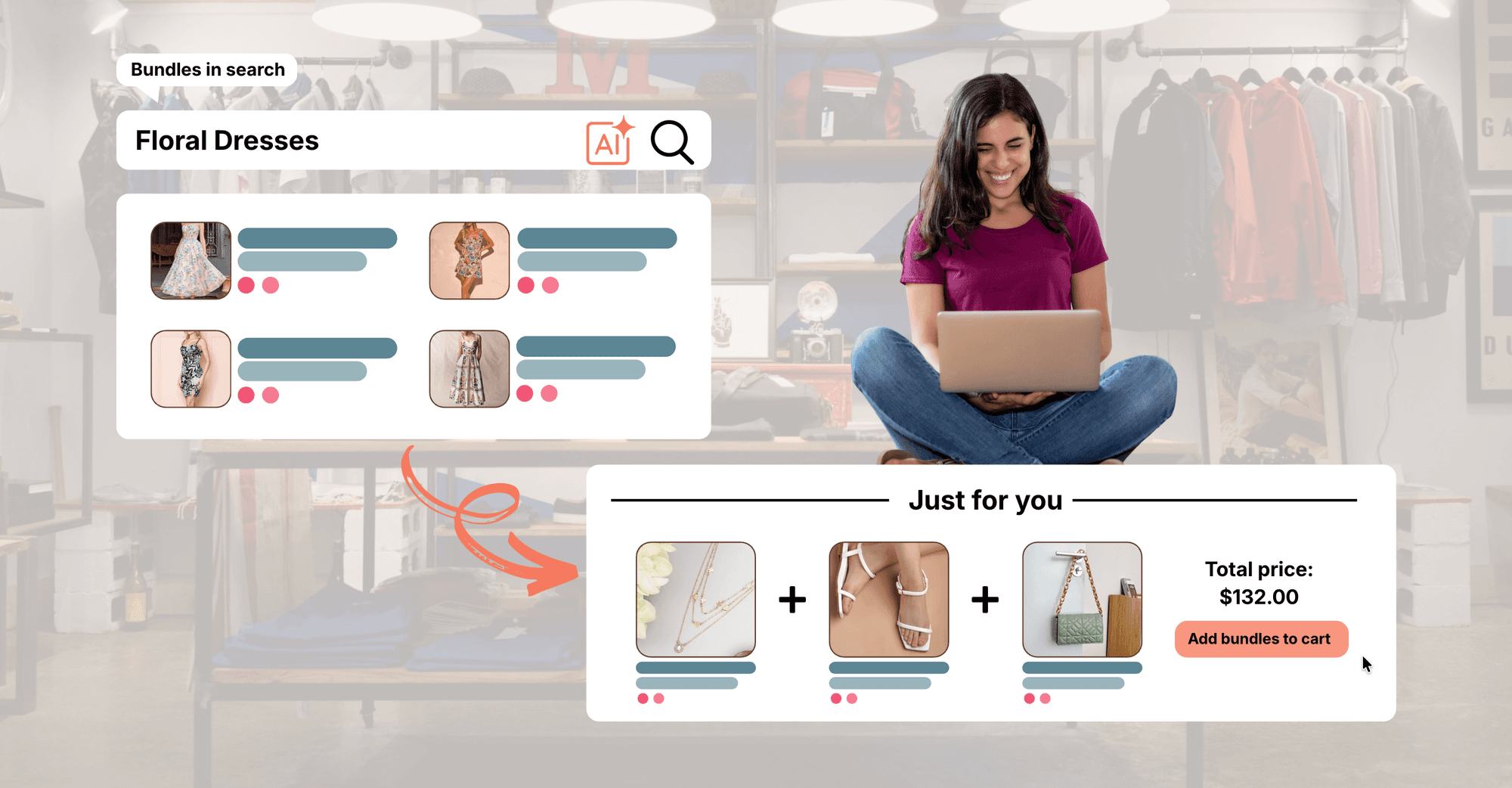
With Glood.AI, the same bundle is not shown to every customer. Instead, a customer browsing a specific subcategory sees the bundle most relevant to their interest.
A returning customer who’s already purchased one of the bundle items sees a "complete the set" framing rather than the full bundle introduction. Meanwhile, first-time visitors see the bundles that have historically worked best as entry points for the brand.
Step 4: Pricing intelligence
Glood.AI shows data on the amount, above the sum of individual item prices, a customer has historically accepted for buying a particular bundle in your catalog, including by category, price range, and customer segment. This helps an eCommerce brand price bundles that capture margin rather than eroding it.
No manual SKU mapping. No hand-drawn decision trees. The AI shows the combinations that brands can easily and quickly review, customize the presentation, and publish on their website.
The Discount Trap: By the Numbers
Now that we’ve explained the mechanics behind bundling, let’s talk about the discount trap.
As a proven fact, repeat buyers who made their first purchase during a discount window have a 30% lower lifetime value (on average), as compared to those who first bought at full price.
Why? Because discounts set the customer's mental price anchor. They didn't decide your $55 protein supplement was worth $55. Instead, because they bought it at a discounted price of $44, for them, this is the actual worth of the product.
This means that a customer will now evaluate their future purchases based on the anchor set. Their full-price offers will feel expensive, and your promotions will feel like the normal purchase occasion. Rather than buying the product today, they’d wait for you to offer it at the discounted price and then make a purchase.
However, AI bundling doesn't lower the perceived price of any individual product. It increases the perceived value of buying multiple products together. For instance, a customer who buys a $55 protein supplement bundled with a $30 shaker bottle isn't thinking "I got a deal." They're thinking, "I got what I need." That's a completely different psychological game, and one that supports higher LTV.
Four Bundle Types That AI Finds For You
Different bundles serve different objectives. Glood’s AI infrastructure identifies which type is most relevant based on what's actually in your transaction data.
1. Complementary bundles
Products that solve adjacent problems in a single purchase are bundled together. For instance, a cleanser, toner, and moisturizer, or a yoga mat, block, and carrying strap. Such bundles exist because a customer's real need is bigger than any single product. Showing the complete solution not only increases average order value, but also product satisfaction. Customers who buy the full routine or the full kit see better outcomes and come back for more.
2. Volume bundles
For consumable products, a 2 or 3-month supply bundle often has the highest per-transaction value in the catalog. The trick is timing. This offer only converts well when shown to customers who are clearly considering long-term use.
AI identifies those signals (multiple views of the same product, browsing FAQ pages about dosage frequency, second purchase of the same item) and shows the volume offer to those sessions specifically.
3. Discovery bundles
Pair a proven bestseller with a lower-velocity product that shares customer affinity. The bestseller does the selling. The lesser-known product gets exposure it couldn't earn on its own. Sell-through on the slower item typically improves 30 to 50% when shown in this context. This is how you manage catalog balance without discounting.
4. Occasion bundles
Glood’s AI finds seasonal and gifting patterns in your transaction history. It maps which product combinations spike together around the holidays, around Valentine's Day, around major sporting events, and festive periods.
These patterns are real, repeatable, and usually invisible unless you're specifically looking for them. Glood.AI shows them ahead of the occasion so you can build the offer before the demand increases, and not just during it.
What the Revenue Math Actually Looks Like
Let's look at a specific example, especially the kind of outcome pattern Glood.AI sees regularly with its clients globally.
Imagine a D2C fashion brand, let's call them ABC Fashion House, doing $2M a year. Their average order value is $55, and 40% of their orders come during promotion windows, averaging $47 after discounts.
ABC Fashion House runs Glood.AI's bundle builder. The AI finds that women buyers typically pair tops with matching accessories in the same session at a 34% rate. It finds that men buying formal shirts often add ties at a 28% rate. Both become prioritized bundle offers, personalized to the relevant visitor profiles.
Three months later:
- Average order value is $74, showing a 35% increase
- The promotional order share drops from 40% to 24%, because customers are finding enough value in full-price bundles that the sale trigger isn't needed as often
- Gross margin per order improves
This is the same traffic, products, and team, but generating $700,000 more in annualized revenue than before. The only variable that changed was product presentation.
Getting Bundle Strategy Right From Day One
A few factors determine how quickly AI bundling performs, and they're worth knowing before you start.
1. Catalog depth matters
The more products you have, the more combinations the AI can evaluate, and the more differentiated the bundle offers can be. eCommerce stores with under 30 SKUs may see limited bundle variety. Meanwhile, those with 100+ SKUs will see richer pattern discovery meaningfully.
2. Transaction history matters
Co-purchase analysis needs enough orders to find statistically meaningful patterns. The AI can start from 300 to 400 orders, but sharpens considerably at 1,000+. If you're at an earlier stage, the recommendations will still work, but they'll be more conservative.
3. Placement matters.
Bundle offers convert much better when shown at moments of active product consideration, the PDP, the cart, and the post-purchase page, rather than on the homepage before the customer has formed any intent. Don't lead with the bundle before the customer has shown interest in a component.
4. What to measure
Bundle attaches rate, average order value delta on bundled vs. non-bundled orders, and gross margin per bundle order vs. promotional order. If the attach rate is low, the problem is either the product combination or the placement. If the margin isn't improving, the pricing logic needs adjustment.
The Margin Is Already There
You don't need to find new customers, launch new products now and then, or run better ads to recover the margin your discount strategy is costing you.
The bundles your customers would buy at full price, because they solve a real need and the combination makes sense, the AI showed it to the right person at the right moment, already exist in your transaction data. They're just not being shown properly.
That's what Glood.AI's bundle builder fixes. It doesn’t invent new products or clever promotions. It simply turns the purchase intelligence already available in your data into product combinations that customers actually want at full price, and with better LTV than any discount-first customer you'll ever acquire.
Sign Up For Our Free Weekly Newsletter
Get the latest e-commerce insights, tips, and strategies delivered straight to your inbox.
You May Also Love to Read
The Inventory Prediction Crisis: Why 2026 is Make-or-Break for eCommerce Brands
In 2026, the inventory crisis facing eCommerce brands is real, measurable, and accelerating. According to a report published by the National Retail Federation, nearly 61% of eCommerce businesses identify inventory management as their single most pressing operational challenge, up from 53% just 18 months ago. This isn't a minor frustration; it’s the difference between brands that thrive and those that watch their margins evaporate. The problem isn't that inventory management is complicated. It's
May 13, 2026
5 Ways to Use OpenClaw for D2C Marketing
We work every day with Shopify brands, trying to do more with less. The conversations are almost always the same. A founder with a great product, a team of three or four, and a growing list of channels: TikTok, Instagram, email, SMS, Reddit, and a dozen more. Each one needs a different format, a different hook, a different tone. The team can usually handle any one of them well. Just not all of them at once. The global D2C market reached $163 billion in 2024 and is projected to reach $595 billio
May 1, 2026
From First Visit to Loyal Customer: How Glood.AI Personalizes the Entire D2C Journey
Most personalization tools optimize one moment. Glood.AI personalizes the entire customer journey, from the first click through the fifth purchase and beyond.
Apr 30, 2026