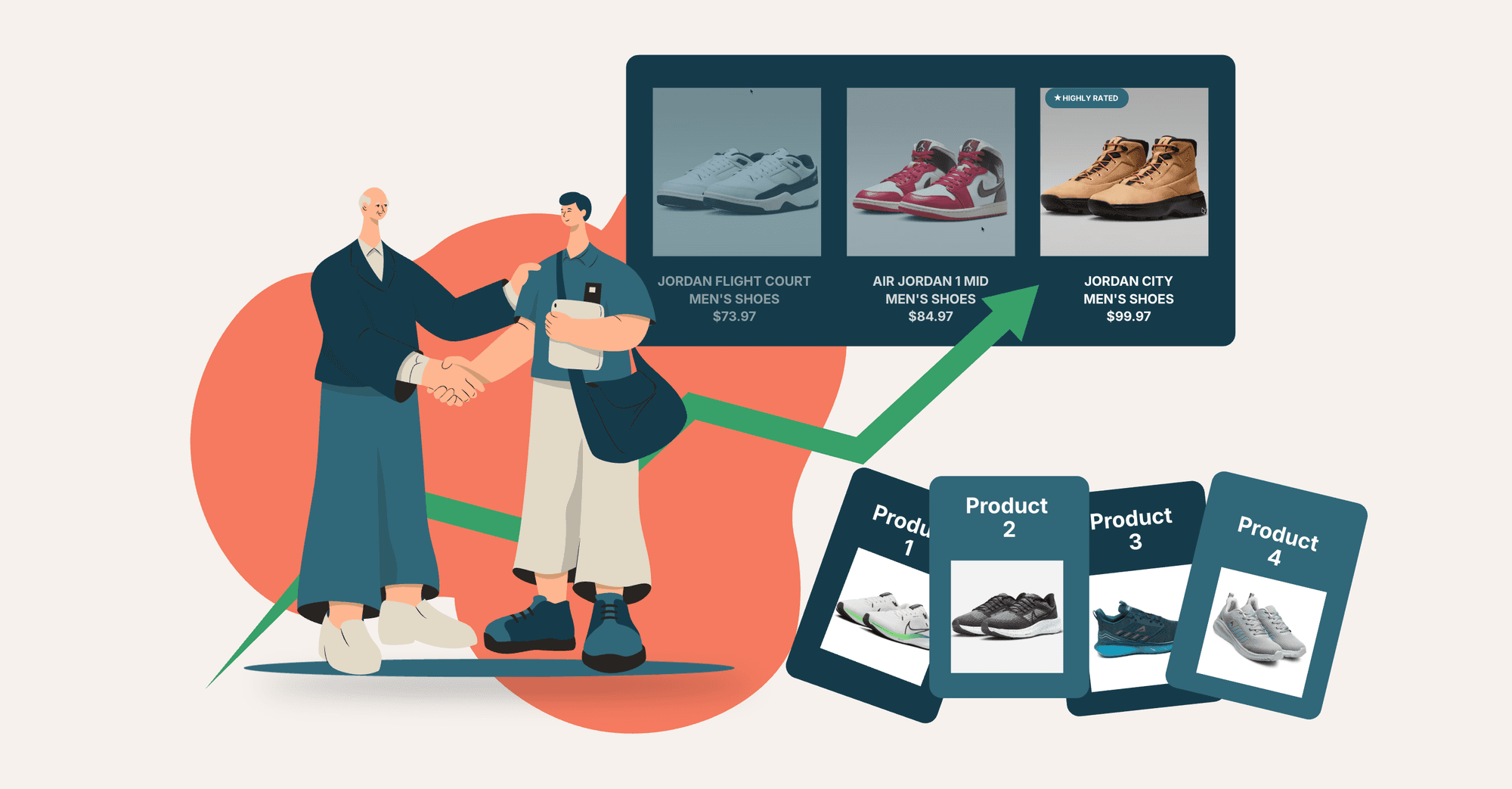


How to Increase Average Order Value on Shopify - The AI Playbook
Read summarized version with
On average, a Shopify store earns around $85-$92 per order. The top-performing stores? They're pulling in $130 or more. The difference isn't traffic volume, product quality, or even brand reputation. It's what happens in the thirty seconds after a visitor lands on the store, and whether the right products show up at the right moment.
Most merchants look at a stagnant AOV and reach for a discount code. That's the wrong move. Discounting might bump short-term conversions, but it doesn't solve the actual problem. The problem is relevance. Customers aren't spending more because they're being shown products that don't connect to what they actually want. That's an AI problem, and AI is exactly how you fix it.
In this blog, let's break down the three moments that actually move AOV, the AI strategies behind each one, and what realistic lift looks like for a real Shopify store.
Why Your AOV Is Stuck, And Why Discounting Won't Move It
Here's what most merchants do when they notice their AOV plateauing: they run a "spend $75, get 15% off" promotion. Conversion ticks up for a week. AOV doesn't budge. Margin takes a hit. And now you've trained your customers to wait for a deal before they spend more.
The data on this is uncomfortable. Stores that rely on blanket promotional pricing see 12–15% higher conversion during sale windows, but 20–25% lower gross margin, a trade that rarely makes sense when you run the full-year numbers. More importantly, it does nothing to fix the underlying dynamic: a shopper who would have spent $110 naturally, if shown the right products, is instead spending $75 with a discount applied.
AOV isn't stuck because your prices are too high. It's stuck because your store isn't showing each customer the products that would complete their purchase. That's a merchandising problem at scale, and at scale, only AI can solve it.

The Three AI Moments That Actually Move AOV
There's no mystery about where the revenue opportunity lives. It sits in three specific moments, and most Shopify stores miss at least two of them every single day.
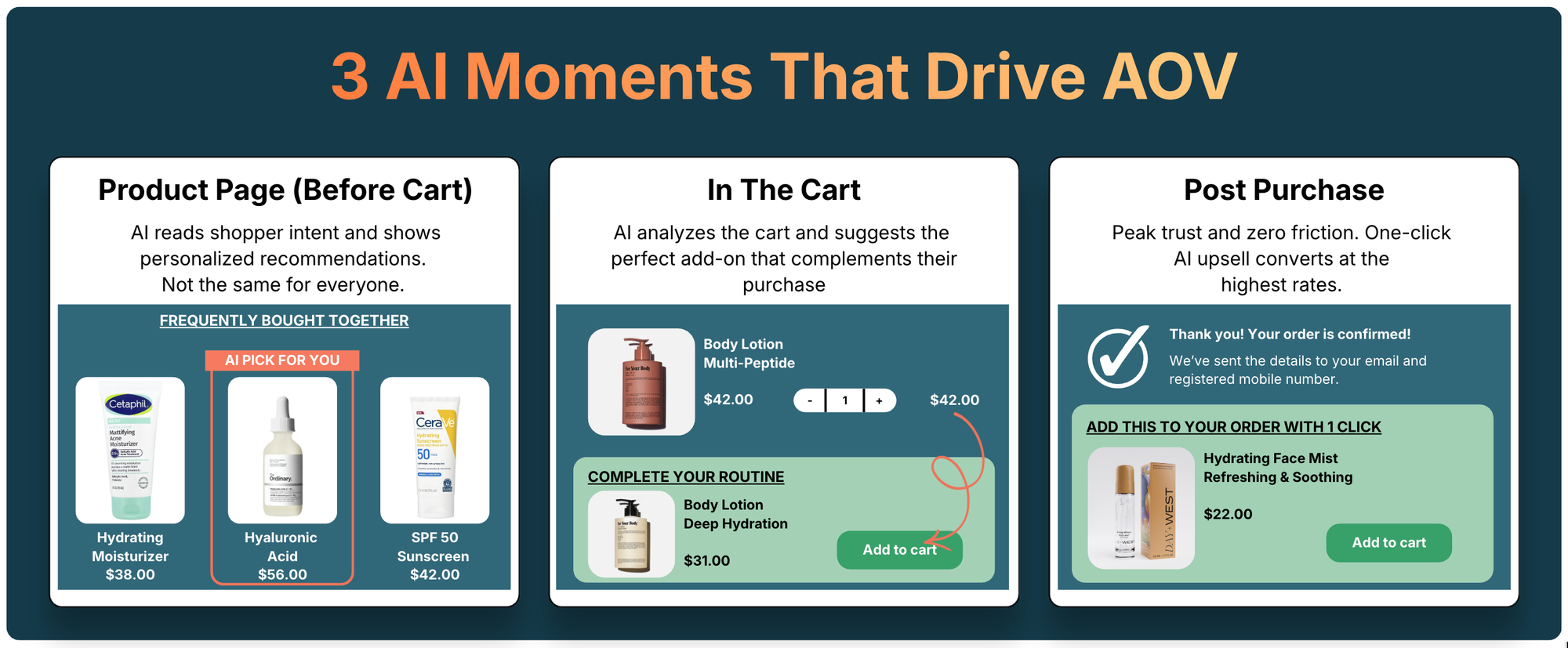
1. On the product page, before the cart
A customer lands on your best-selling moisturizer. Your store shows the same four "You Might Also Like" products to every visitor, regardless of whether they’re browsing SPF products or serums, or they've bought from you before at a $100 ticket. A real AI engine reads that context and shows a recommendation built for this specific shopper. This is not a widget, it’s a revenue decision.
2. In the cart
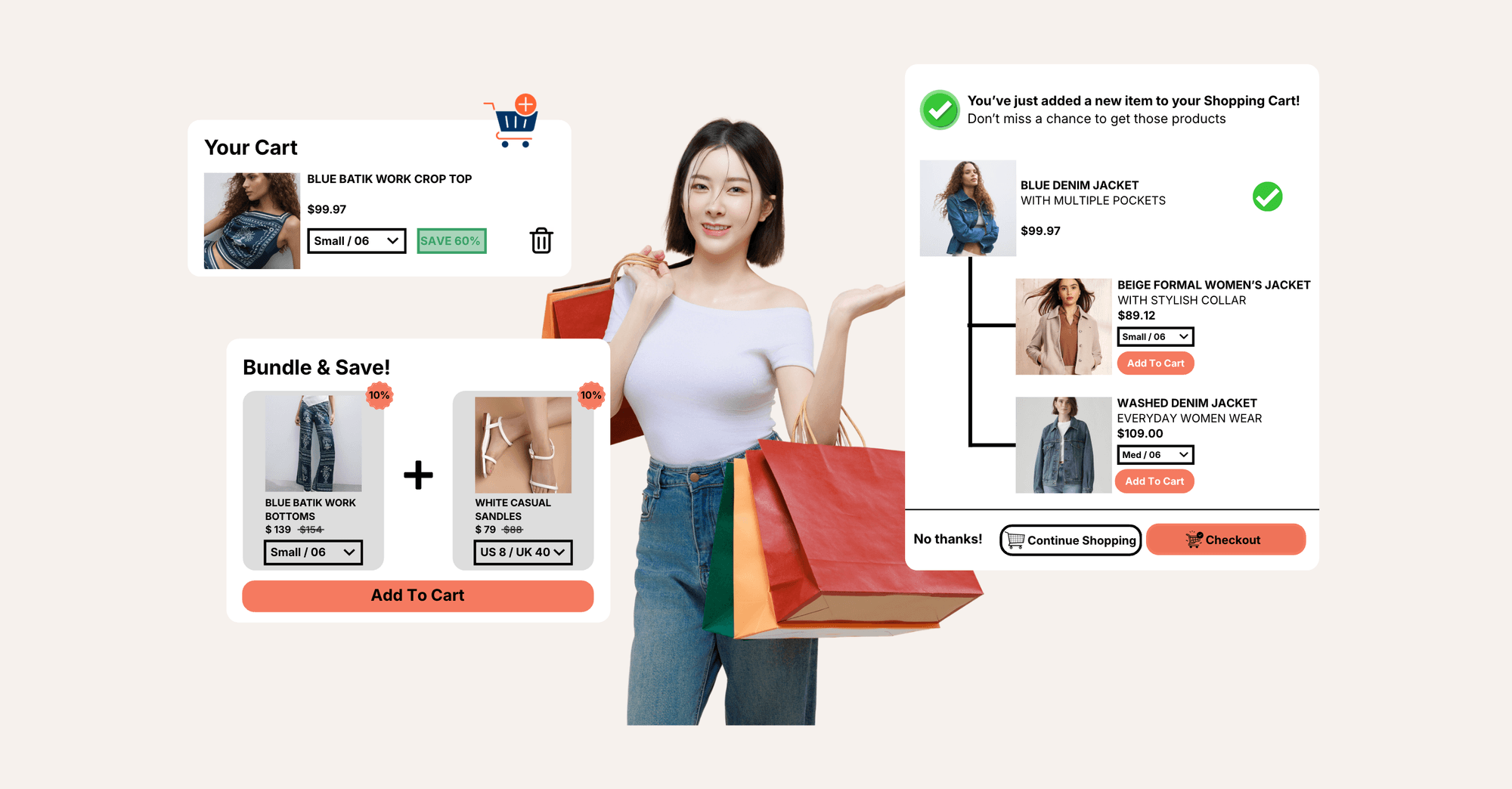
The cart page is the most underused commercial real estate in most Shopify stores. A customer who puts something in their cart has already decided to buy. AI reads the exact product combination sitting there and identifies one complementary item that fits. Not a row of random suggestions, rather a well-chosen prompt.
Stores running AI-powered in-cart cross-sells see attach rates of 8–14% on those recommendations. That's 8 to 14 out of every 100 cart sessions adding a product they wouldn't have found on their own.
3. After the purchase
Most merchants don't touch this at all. The confirmation page gets a "Thank you, your order is on its way" and nothing else. But think about what just happened. The customer handed over their credit card. Their trust is at its absolute highest. Their decision fatigue is gone. Firing one AI-selected, one-click upsell here converts at 15–22% for well-matched products. That's a consistently observed outcome across stores that actually use this touchpoint.
If you miss any one of these three moments, and you're running at a fraction of your AOV ceiling.

What Makes AI Recommendations Work (vs. the "People Also Bought" Widget)
Most Shopify stores have a recommendation widget. Most of those widgets aren't doing what merchants think they're doing.
They're not personalized. They're popularity-ranked. Every visitor sees the same six products because the widget pulls bestsellers and labels them as recommendations. It's the eCommerce equivalent of a gas station displaying the same impulse buys to every single customer who walks in.
Real AI personalization reads the session. It knows that this particular shopper browsed trail-running products before landing on footwear. It knows their cart sits at $80 and they've historically bought at a $120+ ticket. It knows that customers with that behavioral profile, on this device, at this time of day, tend to respond to premium variants rather than entry-level options. All of that inference happens in milliseconds.
The outcome gap is stark:
- Generic "people also bought" widgets contribute to only about 3 to 8% of total eCommerce revenue on average
- AI-driven behavioral recommendations contribute about 15 to 35% for stores that implement them well
Why the gap? Because of relevance. A recommendation that feels like it was chosen for you converts at 3–4x the rate of one that looks like it was chosen for everyone.

Five AI Strategies to Increase Shopify AOV, And With What to Measure
These aren't theoretical. Each of these strategies has a measurable metric that tells you quickly whether it's working.
1. Behavioral product recommendations on PDPs.
AI surfaces products ranked by this shopper's specific interest signals, not by catalog popularity. What to measure: click-through rate on the recommendation widget, and AOV of orders that included a recommended product vs. those that didn't.
2. AI-curated bundle offers on the cart page.
Instead of a static "complete the look" section, AI assembles a bundle based on what's actually in the cart right now. What to measure: bundle attach rate (what percentage of eligible carts accepted the bundle offer) and revenue per session.
3. Smart upsell modals triggered by purchase intent.
When a shopper adds to the cart, a modal fires, not with a random upsell, but with a single, AI-selected upgrade or complement that fits the price range and product category they're already in. What to measure: modal conversion rate and upsell acceptance rate.
4. Post-purchase one-click offers.
A single additional item, recommended by AI, is offered on the confirmation page with a one-click add. What to measure: post-purchase offer conversion rate and incremental AOV per transaction.
5. Personalized homepage product ranking for returning visitors.
Returning customers don't need to see the same products as new visitors do. AI re-ranks the homepage grid based on what this specific customer has browsed and bought before. What to measure: homepage click-through rate for returning visitors, and conversion rate delta vs. a generic control.
How Much AOV Lift Can You Realistically Expect?
The ranges merchants see from AI-powered AOV strategies vary by category, catalog depth, and traffic volume. Here's an honest benchmark.
Fashion and apparel brands with 100+ SKUs typically see a 15–22% life in AOV in the first 60 days of running real-time AI recommendations. Beauty and skincare brands, which tend to have strong natural cross-category purchase patterns, often see 20–30% lifts, because the AI discovers complementary product combinations (serum + SPF, cleanser + toner) that perform consistently. Home goods brands see more variation, typically 10–18%, because the purchase cycles are longer and the behavioral signal volume per session is lower.
What does a 15% AOV lift actually mean in practice? For a store doing $1.5M in annual revenue, a 15% AOV improvement, without changing traffic or conversion rate, adds roughly $225,000 in incremental top-line revenue. The same traffic. The same customers. Just better product surfacing at the right moment.
The compounding effect is worth noting, too. When AOV goes up, your paid acquisition math changes. If you're spending $35 to acquire a customer who spends $70, your ROAS is 2x. If AOV moves to $90, your ROAS improves to 2.6x, and you can afford to acquire more customers at the same efficiency.
Where Most Shopify Stores Get This Wrong
The most common mistake merchants make is treating AI recommendations as a plug-and-play feature that works immediately. It doesn't. AI models need behavioral data to train on; the more transactions your store has processed, the sharper the recommendations become.
In the first 2–3 weeks, expect the AI to lean on catalog metadata and session signals more than purchase history, because purchase history is still accumulating. By weeks 4–6, the model has enough transaction data to start running collaborative filtering, identifying patterns like "customers who bought X also tend to buy Y within the same session." By the 90-day mark, a store processing 500+ orders per month will have a genuinely calibrated model that's noticeably smarter than it was at launch.
The second mistake: putting AI recommendations only on one page. The merchants who see the biggest AOV lifts are the ones running personalization across PDPs, the cart, and the post-purchase moment simultaneously. Each touchpoint reinforces the others. A customer who sees a relevant recommendation on the PDP, a relevant bundle on the cart page, and a relevant offer on the confirmation page is having a fundamentally different shopping experience, one that converts higher and spends more.
Getting Started Without Overhauling Your Tech Stack
You don't need a data science team to run AI-powered AOV optimization. The best personalization platforms for Shopify are native integrations that sit inside your existing store infrastructure. They read your catalog, track behavioral events automatically, and start generating recommendations without a line of custom code.
What to look for when evaluating an AI recommendation tool: real-time session processing (not daily batch updates), native Shopify integration, a cold-start strategy for new products with no purchase history, and clear analytics that show recommendation-influenced revenue separately from organic purchases.
The setup investment is minimal. The compounding returns, as the model learns your catalog and your customers, are not.
Your AOV Isn't a Fixed Number
AOV isn't a baseline you're stuck with. It's a reflection of how well your store connects each customer to the products they actually want to buy. A customer who would naturally spend $120 if shown the right combination of products doesn't magically become a $50 customer; they just become a lost revenue opportunity when your store shows them the wrong things.
AI doesn't just recommend products. It rebuilds the revenue layer of your store, one session at a time. Platforms like Glood.AI are built precisely for this: real-time behavioral recommendations that learn your catalog, personalize to each shopper, and start moving your AOV within the first few weeks, without engineering complexity or manual curation.
The 10–30% AOV lift your store is leaving on the table right now isn't theoretical. It's real, and it's waiting on the other side of better merchandising intelligence.
Sign Up For Our Free Weekly Newsletter
Get the latest e-commerce insights, tips, and strategies delivered straight to your inbox.
You May Also Love to Read