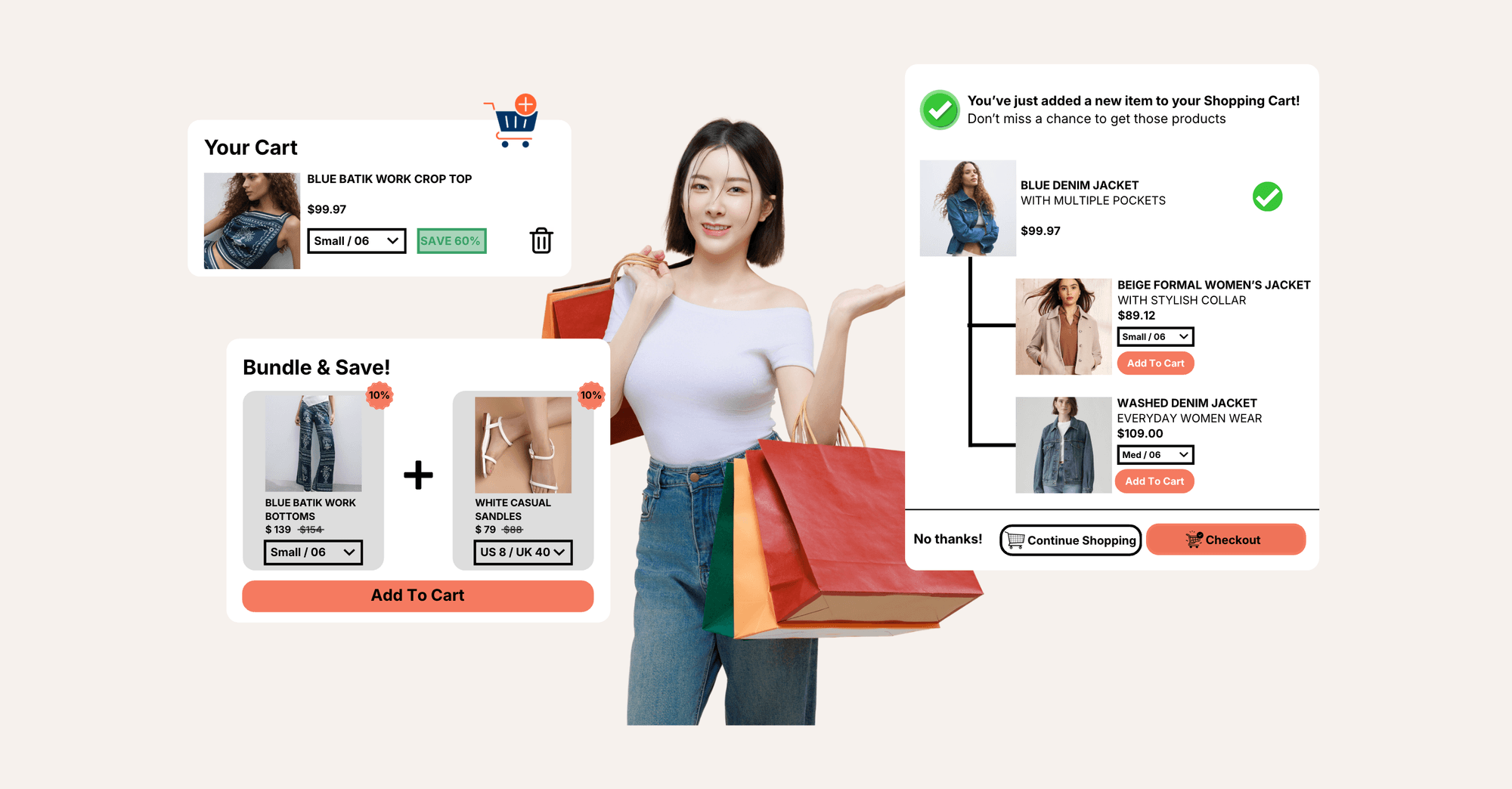

The Complete Guide to AI-Powered Upselling for D2C Brands
Read summarized version with
Most D2C brands upsell incorrectly. They show the same three upgrade options to every customer, the same "you might also like" suggestions, regardless of what's in the cart, what the customer has bought before, or what their price sensitivity actually is. The pop-up fires. The customer ignores it. The merchant concludes that upselling doesn't work for their category.
It does work. It just needs to be relevant. And relevance at scale is an AI problem.
The brands pulling 20–35% of their revenue from upsell and cross-sell strategies aren't doing it with better copywriting or more aggressive pop-ups. They're doing it because they know which offer to show, to which customer, at which moment, and that knowledge comes from an AI model trained on real behavioral and purchase data. This guide breaks down exactly how that works.
What Upselling Actually Means in 2025, And Why Most Stores Are Doing It Wrong
Upselling, in its original form, is simple: offer the customer a more valuable version of what they're already buying. The $25 moisturizer? Here's the $45 version with retinol. The single-serve supplement pack? Here's the 90-day bundle at a better unit price. The concept hasn't changed. The execution has changed completely.
The old model of upselling was manual, static, and indiscriminate. A merchant decided which products to pair, set them up once in the backend, and showed the same combinations to every customer who visited. That approach worked when stores had small catalogs and limited traffic. It doesn't scale. And more importantly, it doesn't personalize, so it doesn't convert at rates that actually move the revenue needle.

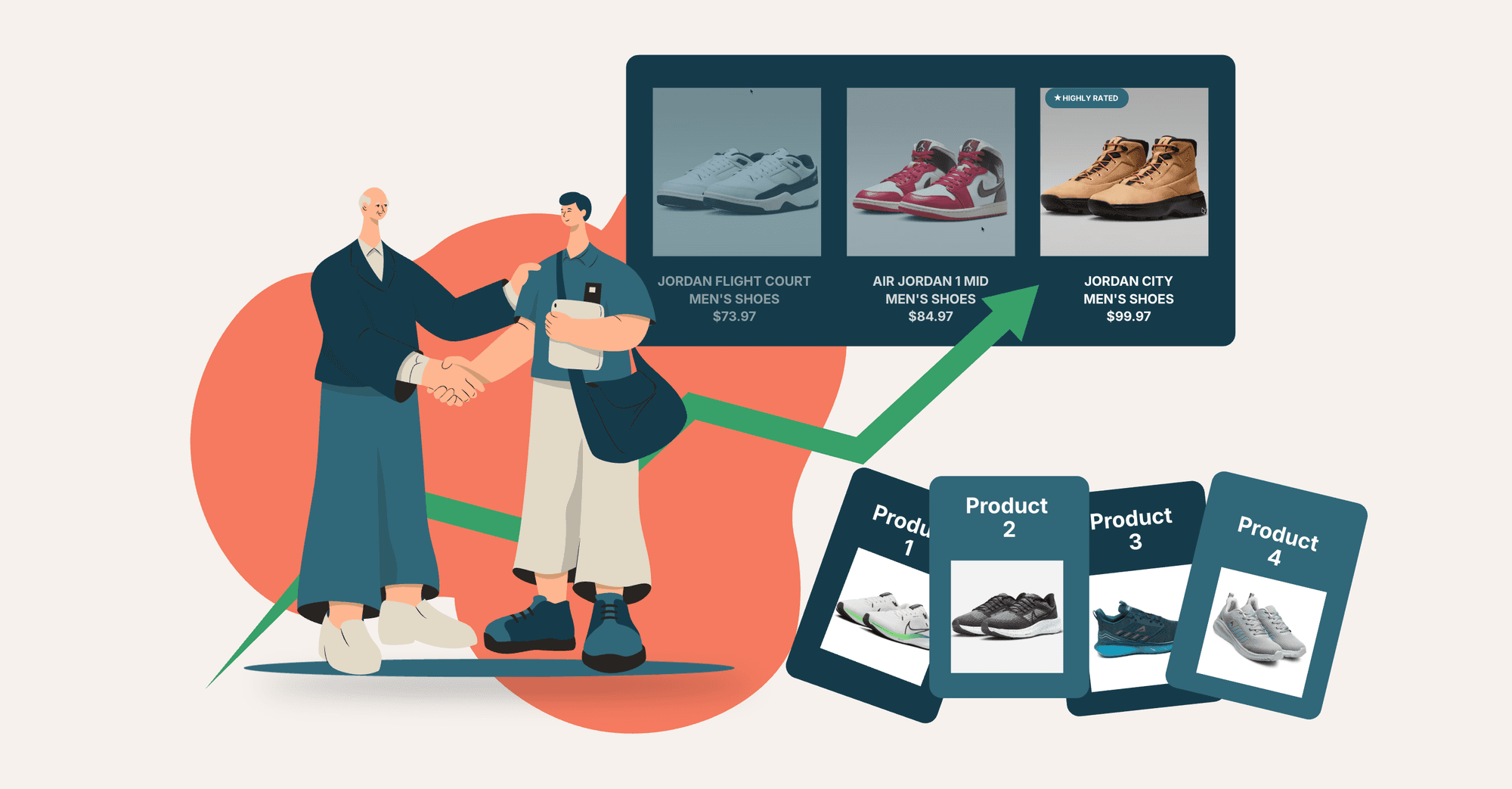
- The distinction worth understanding: Upselling is about showing a customer a better version of what they've chosen. Cross-selling is showing them something complementary. Both require AI to work well at scale, because both require knowing who the customer is and what they actually want, not just what your bestseller list says is popular this week.
- The other thing most brands get wrong: they treat upselling as inherently annoying. A well-timed, relevant upsell doesn't feel pushy. It feels like good service. "You bought the base model, here's the upgrade most customers with your usage pattern prefer" is a helpful message, not a sales tactic. The pushiness happens when the offer is irrelevant. Fix the relevance, and you fix the conversion.
The Upsell Moments That Generate the Most Revenue
Not all upsell moments are equal. The same product offered at different points in the journey converts at dramatically different rates, and understanding why helps prioritize where to focus first.
1. Pre-add-to-cart, on the product page:
A customer is looking at your $30 body lotion. The AI provides a product variant with added SPF and a vitamin C complex, priced at $48, with a short callout explaining why customers who viewed the same ingredient list upgraded to this one. Conversion at this moment depends on the customer not yet having committed to the base option. The offer is in discovery mode, which means it needs to lead with value, not price.
2. Post-add-to-cart modal.
The customer clicks "Add to Cart." Before they see the cart, a single upsell fires, not a menu of options, just one. The best-performing upsells at the moment are premium variants (same product, better formulation or size) or protective add-ons (a case for a phone, a refill for a skincare tool). Conversion averages 10–15% when the offer is AI-selected based on the most recently added product. When it's manually curated and static, it drops to 3–5%.
3. In-cart upgrade.
The cart page is your last structured opportunity to modify the customeris order before checkout. AI identifies whether the current cart composition has a natural premium upgrade, a quantity increase, a bundle, or a kit version of one of the items already selected. The in-cart context differs from the PDP: the customer is reviewing their entire purchase, so multi-item upgrades perform better here than single-product swaps.
4. Post-purchase upsell.
This is the single highest-converting upsell moment in eCommerce, and most D2C brands don't use it at all. Once the order is confirmed, the customer is in a state of peak trust and low decision fatigue; they've already invested mental energy in the purchase decision, and adding one more item to an existing order feels low-stakes.
AI identifies one complementary product, offers it with a single-click add (no cart, no checkout re-entry), and conversion rates regularly hit 15–22% on these offers. For brands that process 1,000 orders a month and convert even 10% of post-purchase offers at an average $20 add-on, that's $24,000 a year in revenue that didn't exist before.
How AI Makes Upsell Offers That Actually Convert
The intelligence in AI-powered upselling isn't magic; it's pattern recognition at a scale humans can't match manually.
Here's what the AI is reading to generate an upsell offer: the product the customer just selected, their full browsing history in this session, their purchase history if they're a returning customer, what other customers with a similar behavioral profile bought together, the current cart value and what price point the upsell should hit to stay within an acceptable range, and whether this customer has seen and declined a similar offer before.
That last point matters more than most merchants realize. An AI-powered upsell system learns from rejections, not just acceptances. If a segment of customers consistently ignores upgrade offers in a certain price band, the model adjusts; it either stops showing that offer to similar profiles or changes the framing. Manual upsell setups don't do this. They show the same offer forever, regardless of how it performs across different audience segments.
The behavioral signals that correlate most strongly with upsell acceptance: browsing multiple product variants on the same PDP (intent to find the right version), viewing ingredient or feature pages in detail (research mode, open to persuasion), and returning visitor status (already trust the brand). AI weights these signals in real time and uses them to decide not just what to offer but whether to offer at all. Sometimes, the best upsell is no upsell, because the customer is in buying mode and friction is the bigger risk.
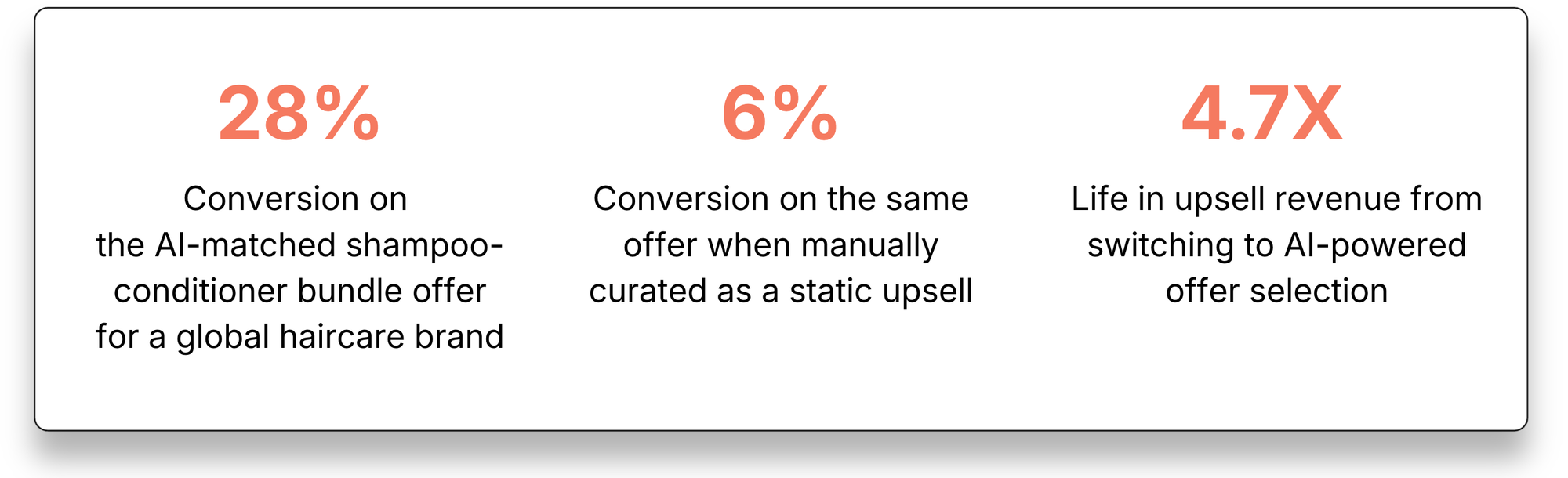
Take a D2C haircare brand, for an example, that operating globally. A customer visits the website, views the $22 shampoo, spends 40 seconds on the ingredient description, clicks on the "for color-treated hair" tag, and views the conditioner on the same page. The AI observes this, identifies that customers with this session pattern accept the shampoo-conditioner bundle offer at a 28% rate, and surfaces it at the post-add-to-cart moment. A static upsell setup would have shown the same conditioner to every shampoo buyer and achieved a 6% conversion rate.
Five Upsell Frameworks D2C Brands Actually Use
These are the mechanics that work, with the AI layer that makes each one perform at its potential.
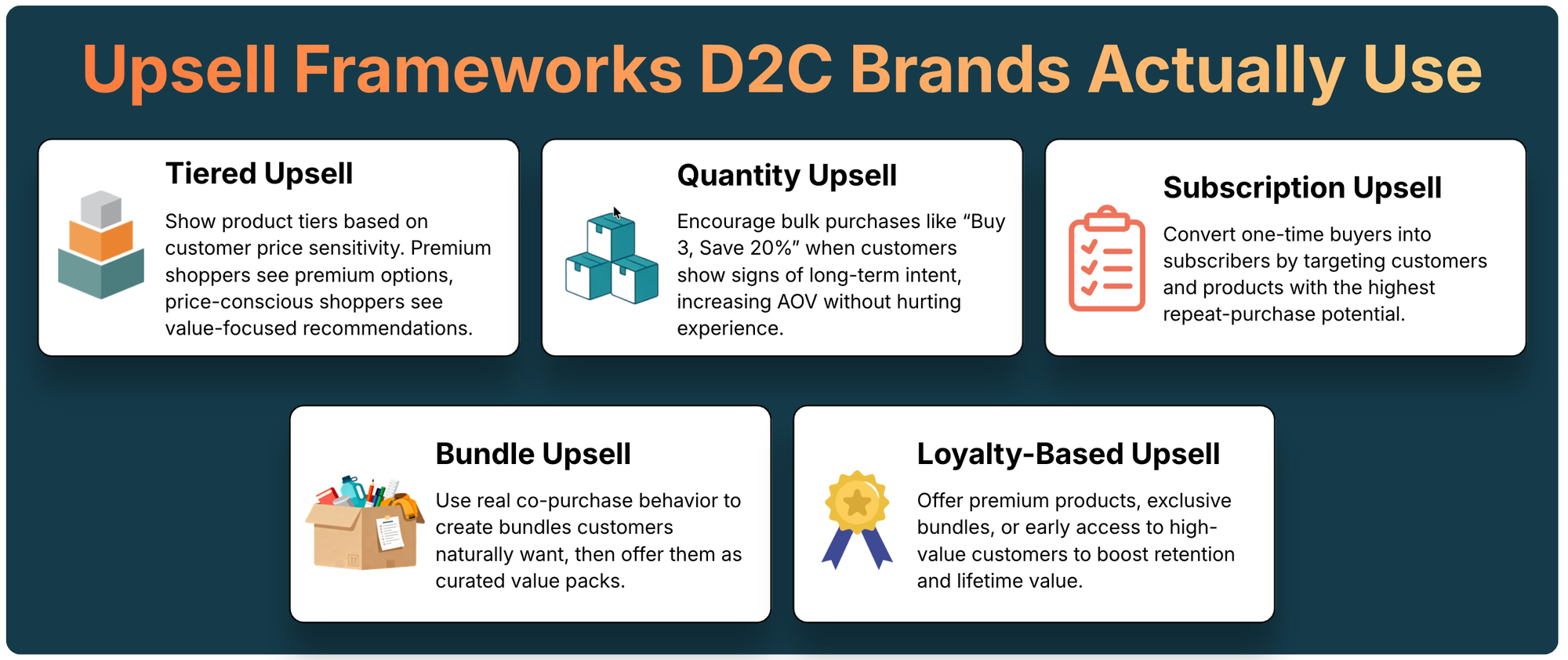
1. Tiered upsell (Good/Better/Best)
You offer three tiers of the same product, and the AI determines which tier to present as the primary recommendation based on the customer's apparent price sensitivity. A customer who's browsed your premium category pages sees the "Best" tier featured. A customer who filtered by lowest price sees a comparison framing that anchors value rather than price.
2. Quantity upsell
For consumable D2C products, supplements, skincare, and coffee, a quantity upsell ("Buy 3 months, save 20%") is often the highest-value offer in the catalog. AI identifies which customers are showing signals of intent to repurchase (viewed the product multiple times, browsed FAQ pages about usage frequency) and times the quantity offer accordingly. Shown to the wrong customer at the wrong moment, quantity upsells feel aggressive. Shown to someone who's clearly considering a long-term commitment, they close at high rates.
3. Subscription upsell
Converting a one-time buyer to a subscriber is the highest-LTV move in D2C commerce. The AI identifies which products have a natural subscription fit (regular consumption, predictable repurchase cycle) and which customers are most likely to convert, typically second-time buyers, or first-time buyers of consumable staples. The offer isn't shown to everyone; it's targeted at the sessions where subscription conversion probability is highest.
4. Bundle upsell
One product becomes a curated set. AI discovers which product combinations have the strongest natural co-purchase affinity in your transaction history, not which bundles you think make sense, but which bundles customers actually buy together. The upsell presents that combination at a slight price advantage over purchasing items individually, positioned as a curated kit rather than a discount.
5. Loyalty-tier upsell
Your highest-LTV customers deserve to see your best products first. AI identifies high-value segments and serves them premium variants, exclusive bundles, or early access offers ahead of general merchandising. This isn't just good for revenue, it's good for retention, because premium customers who feel seen by a brand buy again.
What Separates High-Converting Upsells from Annoying Ones
The difference between a revenue-generating upsell strategy and one that damages the shopping experience comes down to four things.
Timing
An upsell shown before the customer has made their base decision creates friction. An upsell shown after the customer has committed, but before they've finalized, is additive. Get the timing wrong, and you'll see both lower upsell acceptance and lower overall conversion on the original item.
Relevance
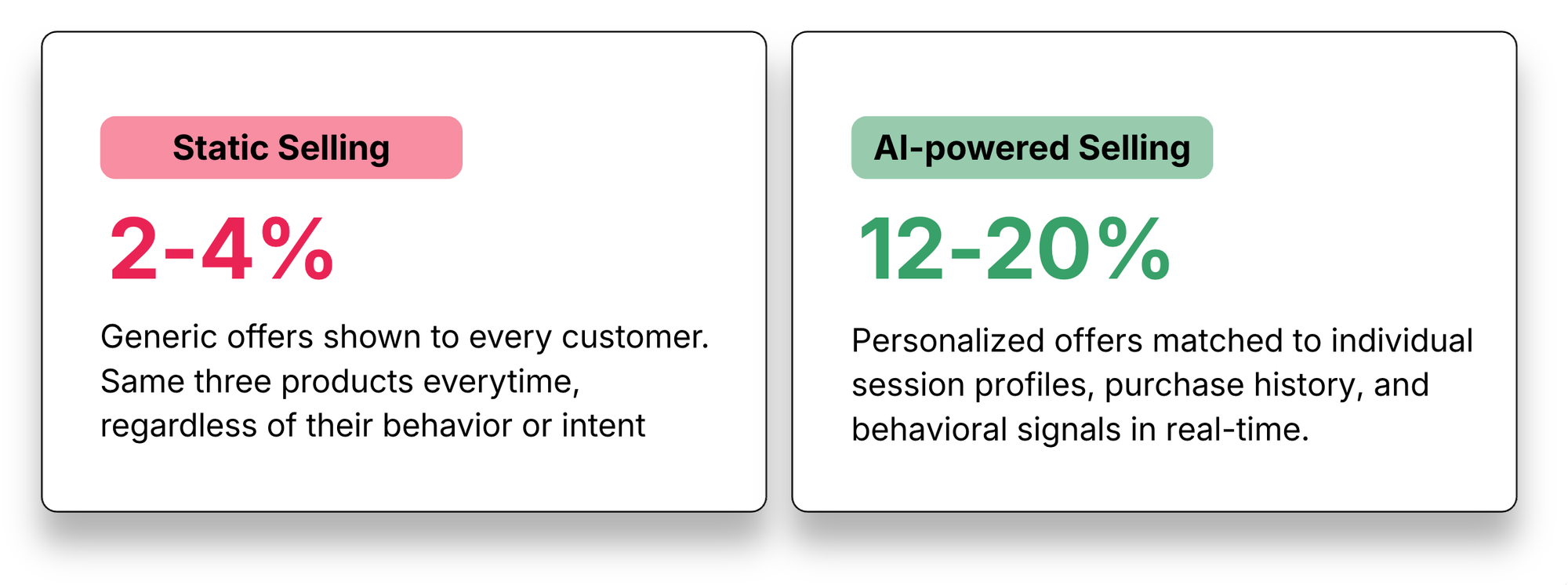
This is the biggest variable. Generic upsells, the ones that show the same three products to every customer, convert at 2–4%. AI-personalized upsells, matched to the individual's session profile and purchase history, convert at 12–20%. The gap exists entirely because of relevance. A customer buying running shoes doesn't need to see your basketball sneakers. They might need to see your performance socks, insole upgrades, or a shoe care kit, if the AI has learned that customers in their profile tend to add these.
Price delta
The most consistent finding across upsell research: offers priced 20–40% above the original item perform best. Below 20%, the upgrade feels too similar to the original to justify the decision. Above 40%, the mental reframing required to accept the upsell becomes too large. AI learns this threshold per-catalog and per-segment; different categories and different customer profiles have different sweet spots.
Friction
Each additional click in the upsell acceptance process costs you a conversion. Post-add-to-cart modals that require customers to re-evaluate pricing, reread a product description, and then click through to a new page lose 60%+ of interested buyers. The best-performing upsells are one tap: "Add to order", done. The AI handles offer selection, and the UX handles the frictionless acceptance.
Measuring Whether Your Upsell Strategy Is Working
Three metrics tell you quickly whether your upsell strategy is performing, struggling, or leaving money on the table.
Upsell attach rate
What percentage of eligible transactions include the upsell? A strong attach rate varies by category, but 8–15% is a healthy baseline for most D2C brands.
- Getting to 15–20% typically requires both AI-powered offer selection and optimized placement.
- Under 5% usually indicates that the offers are incorrect, the product is incorrect, the timing is incorrect, or all three.
AOV delta
What's the average order value of orders that include an upsell vs. those that don't? This tells you the revenue impact per transaction. If your upsell attach rate is 10% and your AOV delta is $20, you're adding $2 per order across your full transaction volume. At 5,000 orders per month, that's $10,000 in incremental monthly revenue, from a strategy that requires zero additional ad spend.
Upsell view-to-accept rate
If your upsell offer is being shown but not accepted at a reasonable rate, the problem is the offer itself - wrong product, wrong price, or wrong positioning. If it's not being shown at a high rate, the problem is placement or trigger logic. These two metrics help you diagnose where the breakdown is happening.

The Revenue Your Store Is Already Leaving Behind
Upselling at scale is an AI problem, not a copywriting problem, not a design problem, not a category management problem. The brands winning on AOV and revenue efficiency aren't running more aggressive promotions. They're showing the right upgrade to the right customer at the right time, consistently across thousands of sessions without manual intervention.
That's what AI-powered upselling looks like in practice. Glood.AI is built to do exactly this: behavioral AI that reads each session, selects the highest-probability upsell offer, and delivers it when the customer is most likely to say yes. Not because it's programmed to push products. Because it's trained to recognize when a recommendation actually helps.
The revenue difference between a store running smart AI upsells and one running static widgets is real, measurable, and compounding. It grows larger every month as the AI model learns more about your catalog and your customers. The question isn't whether to do this, it's how soon you start.
Sign Up For Our Free Weekly Newsletter
Get the latest e-commerce insights, tips, and strategies delivered straight to your inbox.
You May Also Love to Read